
Apple’s Secret Database: How FoundationDB Powers iCloud
Discover how Apple’s FoundationDB and Record Layer power iCloud services for over a billion devices worldwide.

I talk about open source databases, and one thing I always wanted to research was Apple’s database ecosystem which services they use and how they handle data at massive scale.
Table of Contents
What is FoundationDB?
The Problem: Key-Value Stores Aren’t Enough
Apple’s Secret Sauce: The FoundationDB Record Layer
How Apple Uses This Technology in iCloud
iCloud Photos
iCloud Keychain
iCloud Drive and Backup
The Scale of Apple’s Database Infrastructure
Why Apple Open-Sourced This Technology
Lessons for Developers and Architects
Build on Strong Foundations
Layered Architecture Enables Flexibility
Invest in Testing Infrastructure
Schema Evolution is Critical
Getting Started with FoundationDB
The Future of Distributed Databases
FAQ
As expected, Apple uses their own open source database. Just like they created Swift for development, they’ve built their own database infrastructure. So I wanted to share this with you in case you weren’t aware of it.
Ever wondered what happens when you take a photo on your iPhone and it instantly appears on your Mac? Or how your passwords sync seamlessly across all your Apple devices?
Behind the scenes, Apple relies on a powerful distributed database technology that most people have never heard of: FoundationDB.
But FoundationDB alone isn’t the whole story. Apple’s true innovation lies in what they built on top of it the FoundationDB Record Layer a sophisticated structured data layer that transforms a simple key-value store into a robust, scalable database capable of handling billions of transactions daily.
What is FoundationDB?
FoundationDB is an open-source, distributed database designed to handle massive-scale workloads with ACID transaction guarantees. Originally developed by FoundationDB Inc. in 2009, Apple acquired the company in 2015.
Here’s what makes it special:
Distributed Architecture: It scales horizontally across multiple servers and data centers without breaking a sweat.
ACID Transactions: Your data stays consistent even when spread across the globe. No partial writes. No corrupted states.
Fault Tolerance: Servers crash. Hard drives fail. FoundationDB keeps running.
Ordered Key-Value Store: It provides a flexible foundation for building any data model you need.
High Performance: We’re talking millions of operations per second. FoundationDB currently does not support transactions running for over five seconds. In particular, after 5 seconds from the first read in a transaction:
Check: Known Limitations — FoundationDB 7.4.5 documentation
Unlike traditional databases like MySQL or PostgreSQL, FoundationDB doesn’t come with built-in SQL support or complex data structures. Instead, it provides a minimal but rock-solid foundation hence the name upon which developers can build custom data layers.
The Problem: Key-Value Stores Aren’t Enough
While FoundationDB excels at storing and retrieving key-value pairs with transactional guarantees, real-world applications need more.
Applications work with complex objects, not just keys and values. They need fast lookups on multiple fields, not just primary keys. Data structures change over time. Applications need to filter, sort, and aggregate data.
Building these features from scratch for every application would be inefficient and error-prone. Apple needed a reusable solution that could power all of iCloud’s services.
Enter the Record Layer.
Apple’s Secret Sauce: The FoundationDB Record Layer
The FoundationDB Record Layer is Apple’s answer to this challenge. Open-sourced in 2018, it’s a Java library that adds structured data capabilities on top of FoundationDB.
Think of it as the bridge between a simple key-value store and a full-featured database.
Structured Records: Store complex, typed records using Protocol Buffers instead of raw bytes.
Secondary Indexes: Create indexes on any field for lightning-fast queries.
Schema Management: Evolve your schemas without downtime or painful data migrations.
Query Planning: Optimized query execution across distributed data.
Transactions: Multi-record ACID transactions inherited from FoundationDB.
Versionin: Track record versions and changes over time.
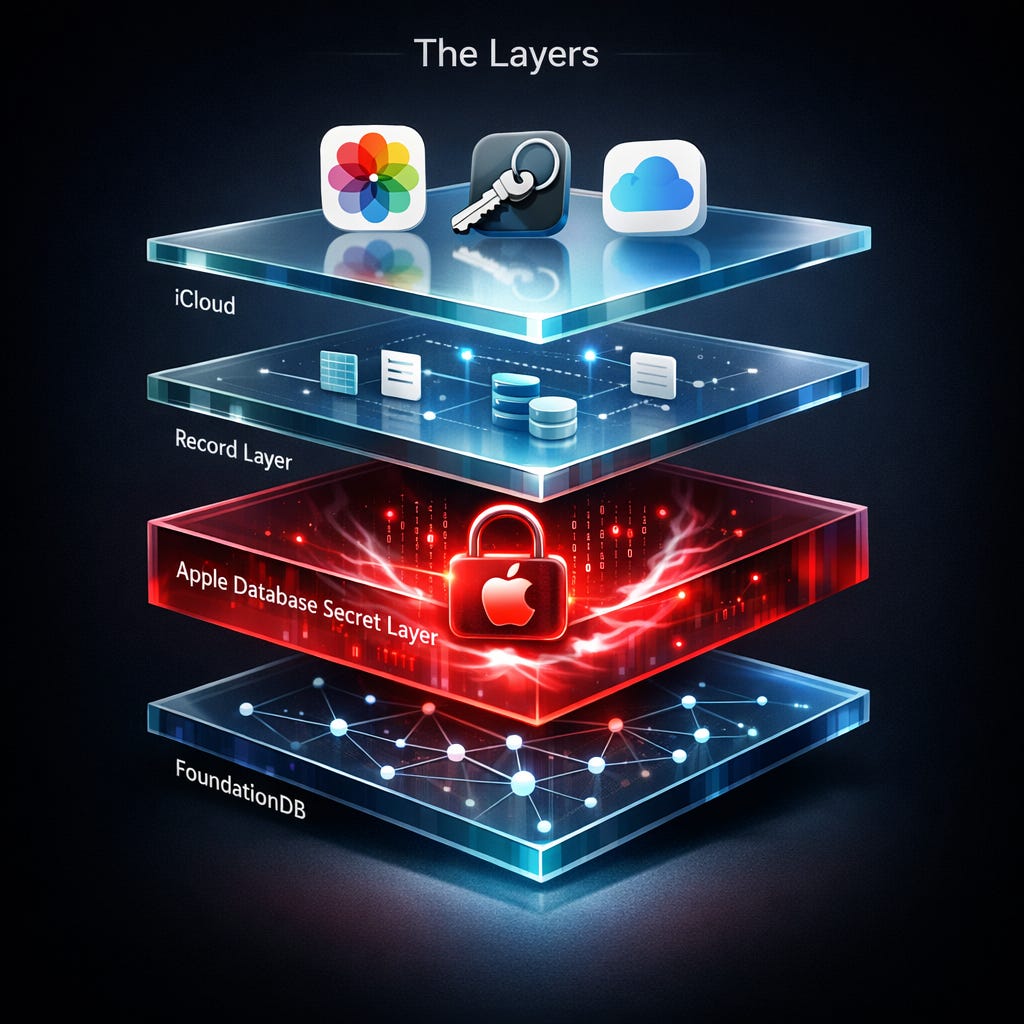
The architecture looks like this:
At the bottom sits FoundationDB Core the distributed key-value store handling replication and transactions.
On top of that sits the FoundationDB Record Layer Apple’s secret sauce providing structured records, indexes, and schemas.
Above that sits CloudKit Apple’s API layer for applications.
And at the very top sit the iCloud Applications Photos, Keychain, Drive, Backup, and everything else you use daily.
This layered architecture allows Apple to maintain a clean separation of concerns. Each layer does one thing well and delegates the rest.
Get production‑grade database insights
Real incident breakdowns, tuning playbooks, and hard‑earned lessons from running databases at scale.
👉 [The PostgreSQL Health Check That Prevents Sev-1s] Price: $29
Health indicators. One function call. No agents, no subscriptions, no data leaving your infrastructure.
How Apple Uses This Technology in iCloud
iCloud Photos
When you take a photo on your iPhone, here’s what happens behind the scenes:
The image is uploaded to Apple’s servers. Metadata timestamp, location, faces detected is stored as a structured record. Secondary indexes enable fast searches by date, location, or person. The Record Layer ensures transactional consistency, so your photo library never ends up in a corrupted state.
That “Memories” feature that magically groups your vacation photos? It’s querying indexed metadata at massive scale.
iCloud Keychain
Your passwords and credentials require the highest level of reliability.
ACID transactions ensure passwords are never partially synced. You’ll never end up with half a password on one device and the other half somewhere else. Encryption is handled at the application layer. Conflict resolution manages simultaneous edits across devices. Fault tolerance means your passwords are always available when you need them.
iCloud Drive and Backup
File synchronization demands complex state management:
Which files exist on which devices? What’s the upload and download queue status? What happens when files are edited simultaneously on multiple devices? How do you maintain backup manifests across billions of devices?
The Record Layer handles all of this with transactional guarantees.
The Scale of Apple’s Database Infrastructure
Apple has publicly shared some impressive statistics about their FoundationDB deployment.
They process billions of transactions daily.
They store hundreds of petabytes of data.
They serve hundreds of millions of active users.
They maintain global availability across multiple data centers worldwide.
To put this in perspective, iCloud serves over 1 billion active Apple devices. Every photo upload, password sync, and file save generates database transactions that must be processed reliably and quickly.
This isn’t theoretical computer science. This is production infrastructure running right now, handling your data as you read this.
Why Apple Open-Sourced This Technology
Here’s where the story gets interesting.
In 2015, when Apple acquired FoundationDB, they made it closed-source. The developer community was frustrated. Projects that depended on FoundationDB were left in limbo.
Then, in 2018, Apple reversed course. They open-sourced both FoundationDB and the Record Layer.
Why?
Community Contributions: External developers help find bugs and improve performance. More eyes on the code means fewer vulnerabilities.
Talent Acquisition: Engineers can learn the technology before joining Apple. It’s essentially a recruiting pipeline.
Ecosystem Growth: Other companies adopting FoundationDB validates Apple’s technical decisions. It’s social proof.
Transparency: Security researchers can audit the code that handles your personal data.
Today, several major companies use FoundationDB:
Snowflake uses it for their cloud data platform metadata. Wavefront (VMware) uses it as their time-series database backend. Apache CouchDB 4.x uses it as their document database storage engine.
Apple’s bet on FoundationDB has been validated by the industry.
Lessons for Developers and Architects
What can we learn from Apple’s approach?
Build on Strong Foundations
Rather than building everything from scratch, Apple leveraged FoundationDB’s proven distributed systems technology. This allowed them to focus engineering effort on higher-level features.
When designing systems, identify which problems have already been solved well. Don’t reinvent the wheel especially when that wheel needs to handle billions of transactions.
Layered Architecture Enables Flexibility
The separation between FoundationDB (storage) and Record Layer (data modeling) allows each component to evolve independently.
Design systems with clear boundaries between layers. This makes maintenance, testing, and upgrades dramatically easier.
Invest in Testing Infrastructure
FoundationDB is famous for its deterministic simulation testing framework. It can test billions of failure scenarios network partitions, disk failures, race conditions all in simulation before code ever hits production.
Robust testing infrastructure is especially important for distributed systems where failures are complex and subtle.
Schema Evolution is Critical
The Record Layer’s schema evolution capabilities allow Apple to update data structures without downtime or complex migrations.
Plan for schema changes from the beginning. Your data model will evolve. Your database should support that gracefully.
Getting Started with FoundationDB
Interested in exploring Apple’s database technology? Both projects are open-source and available on GitHub.
FoundationDB is available for macOS, Linux, and Windows. You can download it from the official GitHub releases page.
The Record Layer is a Java library available via Maven. Add it as a dependency and you’re ready to build.
Good use cases for FoundationDB include:
Multi-tenant SaaS applications requiring strong isolation between customers.
Financial systems needing ACID guarantees at massive scale.
IoT platforms managing billions of device records.
Gaming backends with real-time state synchronization.
Custom databases built on proven distributed infrastructure.
The Future of Distributed Databases
Apple’s approach with FoundationDB and the Record Layer represents a shift in how we think about database architecture.
Rather than choosing between flexibility and reliability, their layered design achieves both.
As applications continue to scale and user expectations for reliability increase, the principles behind Apple’s database infrastructure become increasingly relevant:
Start with a solid distributed foundation. Build structured data capabilities as separate layers. Invest heavily in testing and validation. Design for schema evolution from day one.
The next time your photos sync instantly or your passwords appear on a new device, you’ll know the sophisticated engineering that makes it possible.
Apple’s secret sauce. Running quietly. Handling your data. Billions of transactions at a time.
FAQ
Is FoundationDB a relational database?
No. It’s an ordered key-value store. But relational capabilities can be built on top using layers like the Record Layer.
Can I use FoundationDB for my project?
Absolutely. It’s open-source and free. If you need distributed ACID transactions at scale, it’s worth considering.
FoundationDB 7.4.5 — FoundationDB 7.4.5 documentation
What programming languages does FoundationDB support?
Official bindings exist for Python, Java, Go, C, and Ruby. Community bindings cover other languages.
How does FoundationDB compare to CockroachDB or TiDB?
CockroachDB and TiDB are distributed SQL databases with SQL interfaces out of the box. FoundationDB is lower-level more flexible but requiring more work to use directly. Choose based on whether you want convenience or control.
Is the Record Layer only for Java?
Currently, yes. The official Record Layer is a Java library. The concepts could be implemented in other languages, but Apple’s implementation is Java-only.
The Record Layer abstraction over FoundationDB is what makes this architecture scale so well for Apple's use case. FoundationDB's ordered key-value model is simple but the real power comes from how Record Layer handles schema evolution and secondary indexes on top of it. I've worked with similiar layered approaches and the tricky part is always managing the impedance mismatch between relational semantics and the underlying KV store. Apple's ability to run billions of iCloud operations on this stack without major incidents speaks to how solid the transaction guarantees are. The fact that they can do complex queries while maintaining ACID properties at that scal is pretty wild.