
What I Capture During a PostgreSQL Sev‑1 So My RCA Isn’t Guesswork
Learn why PostgreSQL root cause analysis often fails after Sev-1 incidents, how evidence disappears, and how DBAs should approach incident RCA correctly.

Table of Contents
The PostgreSQL Sev-1 Pattern Everyone Recognizes
Why PostgreSQL Root Cause Analysis Often Feels Unsatisfying
RCA Structure
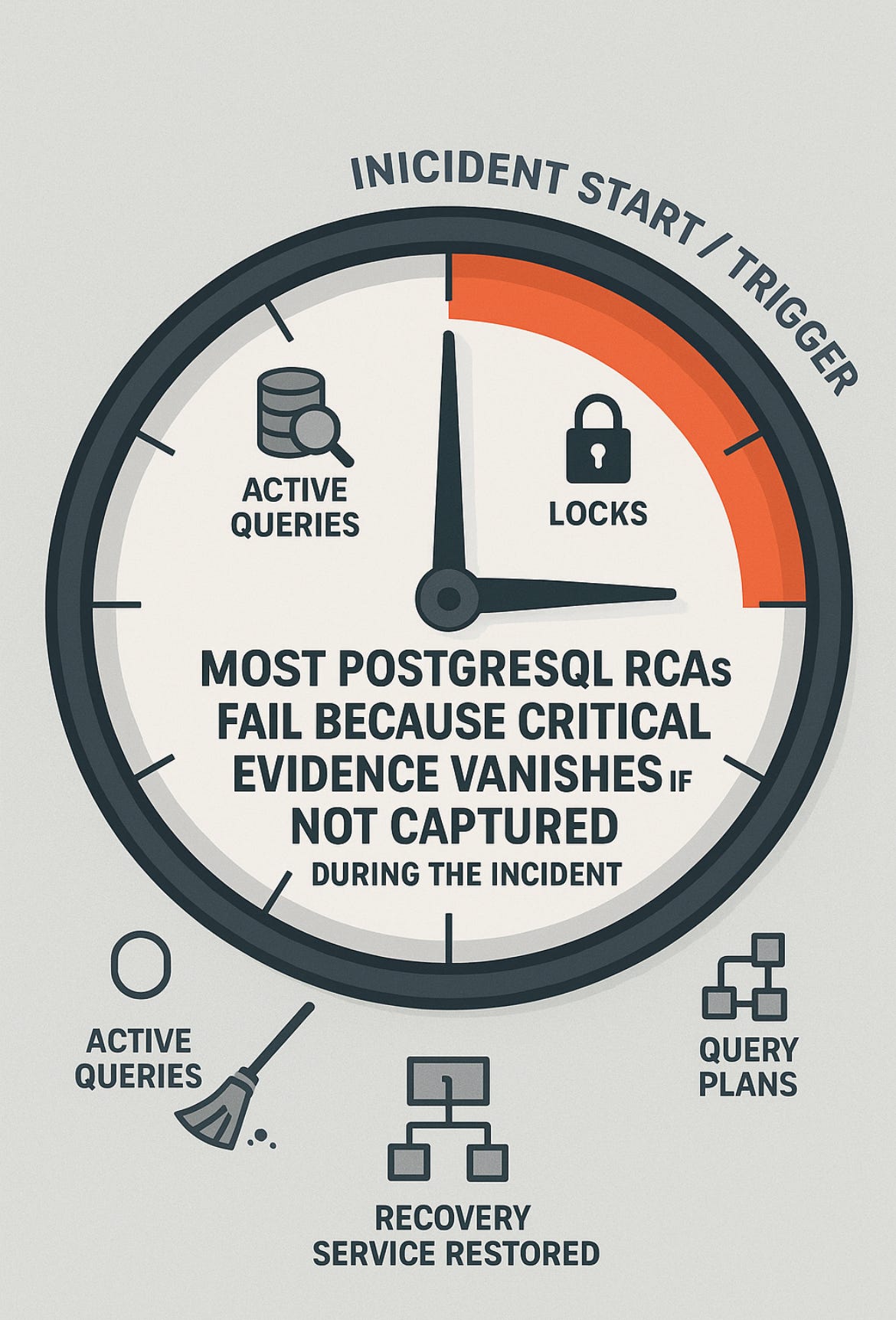
The Real Problem: PostgreSQL Evidence Disappears After Recovery
The Shift That Fixes PostgreSQL RCA: Start During the Sev-1
What Evidence Matters During a PostgreSQL Sev-1 Incident
Redefining Root Cause in PostgreSQL Incident Analysis
Weak vs. Strong PostgreSQL RCA: (Examples)
What to Do Before the Next PostgreSQL Sev-1
Practical Next Step (and the fastest way to stop high load RCAs)
FAQ
The PostgreSQL Sev-1 Pattern Everyone Recognizes
If you manage PostgreSQL in production long enough, you’ve lived this exact database incident response scenario:
PostgreSQL latency increases
Application errors appear
Database monitoring alerts fire
Traffic backs up
A Sev-1 incident is declared
The PostgreSQL database is stabilized
Then, after recovery, leadership asks:
What was the root cause of this PostgreSQL outage?
This is where many PostgreSQL Root Cause Analysis (RCA) efforts begin and quietly fail. Not because the DBA team lacks skill, but because database RCA often starts after the evidence has already disappeared.
Why PostgreSQL Root Cause Analysis Often Feels Unsatisfying
Common conclusions look like this:
High load caused slow queries
Lock contention blocked transactions
Autovacuum caused performance issues
A missing index was identified
These are symptoms. They describe what PostgreSQL was doing, not why a Sev-1 became inevitable.
Effective database incident root cause analysis must explain timing, amplification, and inevitability not just symptoms.
RCA Structure
1. Requirement
What problem are we analyzing?
Clearly define the scope and impact of the incident.
2. What Good Looks Like
What should have happened?
Describe expected behavior, SLAs, and success criteria.
3. Timing
Why did this happen now?
Link the incident to a trigger such as a change, growth threshold, deployment, or traffic shift.
4. Amplification
What caused the issue to snowball?
Identify factors like pool saturation, retries, lock chains, or queueing collapse.
5. Inevitability
What made the failure unavoidable?
The Real Problem: PostgreSQL Evidence Disappears After Recovery
PostgreSQL is highly adaptive. After recovery:
blocking ends
lock queues clear
pg_stat_activitylooks normalquery patterns stabilize
autovacuum catches up
logs rotate
By the time a formal Sev-1 RCA happens, teams rely on memory and graphs so the postmortem becomes guesswork.
This is why many database postmortems feel vague, defensive, or inconclusive.
The Shift That Fixes PostgreSQL RCA: Start During the Sev-1
A critical mindset shift for DBAs:
PostgreSQL root cause analysis starts during incident response not after recovery.
The primary goal during a Sev-1 database outage is restoring service.
The secondary goal equally important is preserving RCA evidence.
You do not need every metric.
You need the evidence that explains cause, amplification, and failure of controls.
What Evidence Matters During a PostgreSQL Sev-1 Incident
1. Database Activity (PostgreSQL Workload Analysis)
Capturing active queries, execution time, and application names helps answer:
Which queries dominated PostgreSQL CPU or IO?
Was this normal workload or an abnormal spike?
Which application or service triggered database pressure?
Without this data, PostgreSQL RCA defaults to:
The database experienced high load
Which provides no actionable insight.
2. Lock Contention and Blocking Analysis in PostgreSQL
Lock-related PostgreSQL outages are especially difficult to analyze post-incident because lock contention disappears after recovery.
Preserved lock data answers:
Which sessions were blocked?
What PostgreSQL lock types were involved?
Why did the application workload fail to tolerate locking?
This transforms RCA language from:
PostgreSQL was blocked
to
A DDL operation acquired an AccessExclusiveLock during peak traffic, blocking critical transactions.
3. Query Performance and Plan Regression Analysis
Many PostgreSQL Sev-1 incidents are triggered by query plan regressions or sudden changes in query execution behavior.
Evidence answers:
Did query execution counts spike?
Did a query plan change due to statistics or data growth?
Did a previously safe query become dominant?
This elevates RCA from:
A slow query caused the issue
to
Data growth and stale statistics caused a query plan regression that amplified load.
4. Autovacuum, Bloat, and Transaction Debt Analysis
Autovacuum frequently appears in PostgreSQL outage postmortems often incorrectly blamed as the cause.
Preserved vacuum and bloat indicators help determine:
Whether autovacuum was reacting to accumulated technical debt
Whether long-running transactions blocked cleanup
Whether table growth outpaced maintenance capacity
This reframes the RCA from:
Autovacuum caused the PostgreSQL outage
to
Transaction patterns and bloat forced autovacuum into emergency behavior.
Redefining Root Cause in PostgreSQL Incident Analysis
In PostgreSQL performance troubleshooting:
High CPU usage is not a root cause
Lock waits are not a root cause
Autovacuum activity is not a root cause
Root cause is:
The earliest preventable decision that made the PostgreSQL incident inevitable.
This could be:
migrations shipped without guardrails (
lock_timeout, safe rollout)unbounded batch workloads
no statement timeout
missing visibility into long-running transactions
stats maintenance not keeping up with data growth
Weak vs. Strong PostgreSQL RCA: (Examples)
Example 1: High load
Weak RCA (symptom):
High load caused latency.
Strong RCA (root cause + timing + amplification):
A new batch job launched at 02:14 ran 200 parallel queries, saturated the connection pool, and retries amplified load until service failure.
Example 2: Lock contention
Weak RCA (symptom):
Lock contention blocked transactions.
Strong RCA (root cause + timing + amplification):
A migration acquired an AccessExclusiveLock during peak traffic; blocked requests queued, exhausted the pool, and the application’s retry policy multiplied traffic.
Example 3: Autovacuum
Weak RCA (symptom):
Autovacuum caused performance issues.
Strong RCA (root cause + timing + amplification):
A 72-hour transaction blocked vacuum, bloat accumulated, and emergency maintenance collided with peak workload.
Example 4: Slow query
Weak RCA (symptom):
A slow query was identified.
Strong RCA (root cause + timing + amplification):
Data growth plus stale statistics triggered a plan regression (index scan → sequential scan), making one query dominant and amplifying I/O.
What to Do Before the Next PostgreSQL Sev-1
Decide the evidence you always capture (workload, locks, query stats, vacuum debt, timeline).
Automate snapshots.
Treat evidence as incident-critical data, not nice to have.
Because the worst outcome isn’t downtime it’s recovering without knowing why it happened.
Practical Next Step (and the fastest way to stop high load RCAs)
If you want this to be repeatable at 2AM, package it into a single command.
That’s exactly what your PostgreSQL Health Report Function does: it captures a broad incident snapshot (connections, locks, wait events, query hotspots, vacuum/bloat, index health, replication, checkpoints) and returns prioritized remediation commands.
If you want one command to capture RCA evidence before it disappears, run it the moment a Sev-1 is declared:
SELECT * FROM public.run_health_report();
SELECT * FROM public.health_critical;
SELECT * FROM public.health_score;
SELECT * FROM public.health_alerts;
Price: $29 – Includes 2 Files: 👉 [Buy the Updated PostgreSQL Health Report]
FAQ
What is PostgreSQL root cause analysis?
PostgreSQL RCA identifies the earliest preventable decision that made a Sev-1 inevitable, explaining timing and amplification not just symptoms.
Why do PostgreSQL RCAs often fail?
They start after recovery, when locks clear, sessions end, stats normalize, and logs may rotate so evidence is missing.
Is autovacuum usually the root cause of PostgreSQL outages?
No. Autovacuum is rarely the root cause. It usually reacts to deeper issues like transaction debt, table bloat, or long-running transactions.
What evidence should DBAs collect during a Sev-1 PostgreSQL incident?
Active queries and execution times
Lock contention and blocking chains
Query execution frequency and plan behavior
Vacuum, bloat, and transaction age signals
Every change you make right down with timeline
How can DBAs prevent repeated PostgreSQL Sev-1 incidents?
Capture RCA evidence during incidents
Identify amplification patterns (locks, regressions, bloat)
Add guardrails instead of only alerts
Write RCAs that drive architectural improvements
If you’ve handled a PostgreSQL Sev-1 and struggled to explain the real cause, this publication is for you.
Follow for practical insights, postmortems, and frameworks to make your next RCA meaningful and actionable.
The framing of RCA as starting during the incident, not after, is powerful. Most teams ive worked with treat evidence collection as optional during firefighting, then spend days reconstructing what happend. The distinction between symptoms and root cause is key tho - saying autovacuum caused the outage vs recognizing vacuum got blocked by a long txn. The examples showing weak vs strong RCAs nail exactly what separates productive postmortems from ones that just document pain without preventing recurrence.