
[Premium] PostgreSQL OOM Crash: 11 Diagnostic Queries
How to Diagnose, Fix, and Prevent Linux OOM Killer from Terminating Your Database

Table of Contents
The Incident: Understanding PostgreSQL OOM Crashes
Why PostgreSQL OOM Crashes Happen
Top 11 Diagnostic Queries
Query 1: Active Backends by Runtime
Query 2: Your Session Memory Breakdown
Query 3: Parallel Query Workers Detection
Query 4: Current Parallel Execution Configuration
Query 5: Idle Connections by State
Query 6: Individual Long-Idle Connections
Query 7: Calculate Safe work_mem
Query 8: High-Memory Query Patterns
Query 9: Memory Health Summary
Query 10: Connections by Application
Query 11: Current Memory Configuration
Configuration Reference
OOM Prevention Settings
Role-Based work_mem Strategy
Session-Level Override
Core Principles
Get production‑grade database insights
Real incident breakdowns, tuning playbooks, and hard‑earned lessons from running databases at scale.
👉 Subscribe to get new posts directly in your inbox
👉 [The PostgreSQL Health Check That Prevents Sev-1s] Price: $29
60+ health indicators. One function call. No agents, no subscriptions, no data leaving your infrastructure
The Incident: Understanding PostgreSQL OOM Crashes
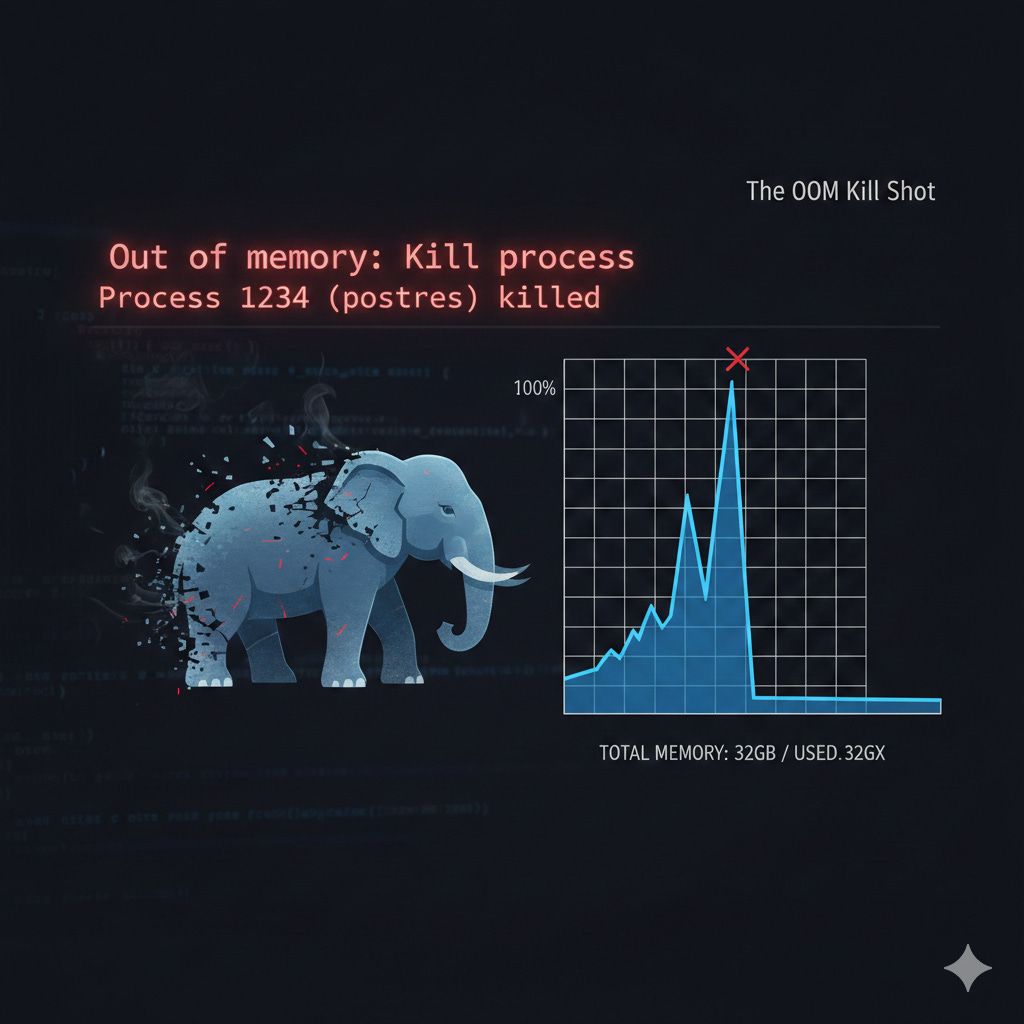
Your monitoring shows a sudden drop in connections followed by a service restart. The system log reveals:
Out of memory: Kill process 12345 (postgres) score 950The Linux kernel terminated your database because PostgreSQL attempted to consume more RAM than available. This triggers crash recovery, causing 30 seconds to 20+ minutes of complete unavailability depending on WAL volume.
Important context: PostgreSQL memory consumption is dynamic and non-deterministic. The queries in this post rank risk and identify suspects. All memory figures represent PostgreSQL internal allocations, not OS-level RSS.
Why PostgreSQL OOM Crashes Happen
The primary cause is misconfigured work_mem combined with parallel query execution.
The work_mem multiplier effect:
work_memallocates per executor node, not globallyA single query with 3 hash joins, 2 sorts, and 4 parallel workers consumes:
work_mem x 5 operations x 4 workers = 20x work_memLinux memory overcommit allows allocation promises until physical RAM runs out
The OOM killer terminates the process with the highest memory badness score
Query 1: Active Backends by Runtime (Run First)
Purpose: Identify which active connections are running the longest and may be consuming memory.
Version: PostgreSQL 14+
Scope: ALL active backends on the server
